Silhouette lines that flow effortlessly across the paper in the unmistakeable shape of a female figure is often what at first grabs the attention of the viewer of Bennett’s work. Then comes colour. Pink, rose, tangerine, a zingy orange or a racing green sharpens the hand-drawn contours seemingly drifting on top of an often neutral backdrop; lines depicting her subjects in a pose that may portray a moment of reflection or be outright suggestive. Bennett may entice her audience like the mythologic sirens of classical antiquity, and through compositions which are aesthetically pleasing she has come to master a visual language that tells a complex tale of a personal exploration of the female body and identity.
Feminine influences trace back to Bennett’s earliest works. Exiting the nineties, ‘girl power’ had influentially made a wave, starting as a ripple in the publication ‘Bikini Kill #2’ in ’91. In just a few years the two-word slogan cemented itself as an undeniable force in the mainstream, filtering into fashion, music and everyday vocabulary. It was a celebration of women’s empowerment and positivity. Bennett’s first acrylic paintings on board from 2001 exude the new confidence. Girls wearing bras and underwear pose alluringly in oversized men’s uniform jackets and hats, signalling a break from the status quo by engagingly confronting the patriarchal media landscape of the day. Keeping away from details within the work, and utilising a palette of dusted block colours, Bennett cleverly uses negative space to define the contours of the female figures and their masculine clothing.
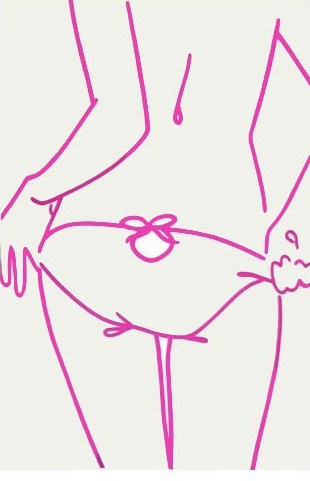
LUCIE BENNETT
Pink Knickers, 2005
Edition of 95
61(w) x 94(h) cm
24.02(w) x 37.01(h) inches
LUCIE BENNETT
Pink Knickers, 2005
Edition of 95
61(w) x 94(h) cm
24.02(w) x 37.01(h) inches
|
|
|
61(w) x 94(h) cm
24.02(w) x 37.01(h) inches
|
Screenprint on Somerset satin paper.
Signed, titled and numbered on front.
Edition of 95
|
|
The sweep of a silhouette line that is instantly recognisable as one drawn by Bennett first appears in her ‘Frill’ series from 2002. Painting with a black line onto liquid latex covered canvases of primary colours, she presents her subjects as line-drawn figures only. One woman, ‘Candy 2’, is portrayed in a buttoned-down, short nurse uniform and in ‘Candy 3’ she looks straight at the viewer while sucking on two fingers, wearing a negligée and a teddy bear under one arm. The following year, Bennett introduced new and more insistent characters in ‘Red Pistol’ and ‘Yellow Pistol’. Now armed, the message packs a punch and is directed straight at the viewer through the barrel of a gun on strong primary-coloured backgrounds. Women with animal ears and tails crouch in combat position - as hunters not hunted. In a review of the show from the time, The Art Newspaper took notice, stating that “Traditionally bunny girls are compliant little things, in these works of Bennett’s they are anything but.” Harnessing energy from animal and primal nature, these works represent power, growth and purpose, signalling a new beginning.
Although some of the compositions may feed into a male fantasy, ‘Candy’ and her gun-slinging friends are not the objectified females visible in the media landscape. Bennett’s women own their sexuality and power.
Starting with multiple sketches by hand, Bennett methodically evolve her subjects in simple pencil lines on paper, allowing collages and cut-outs to take part in the process to achieve the desired ideas and introduce a palette that complements the character. Colour plays a crucial yet understated role in Bennett’s work, often asserting itself quietly rather than demanding attention; every so often only making its existence known by sneaking into the title in many of the works. It is a supporting yet vital and carefully considered aspect that perfects the artist’s objectives with each work.
The London solo show at Eyestorm in 2005 showcased a body of works on aluminium, representing Bennett’s earliest studies of women’s role in society, and the cultural and social dimensions. These unique works became an inspiration in creating a series of print editions that today have become iconic and ones that distinguish the artist’s style. Within the series, five images were introduced.
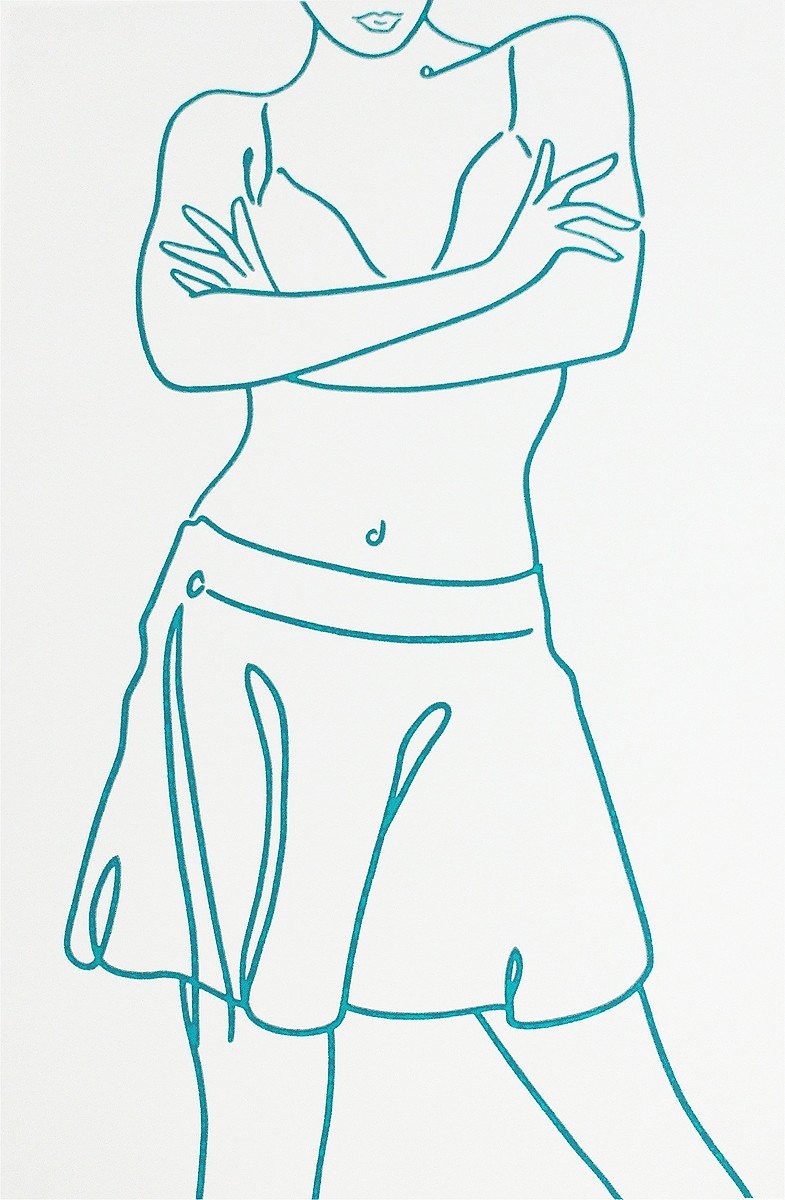
LUCIE BENNETT
Airforce Blue, 2005
Edition of 95
20 Artist Proof (APs)
94(w) x 61(h) cm
37.01(w) x 24.02(h) inches
LUCIE BENNETT
Airforce Blue, 2005
Edition of 95
20 Artist Proof (APs)
94(w) x 61(h) cm
37.01(w) x 24.02(h) inches
|
|
|
94(w) x 61(h) cm
37.01(w) x 24.02(h) inches
|
Screenprinton Somerset satin paper.
Signed, titled and numbered on front.
Edition of 95
|
|
In
Airforce Blue, a woman stands with her arms crossed and the hip moved to one side. However defiant the pose, there is a playfulness to her, hinted by the barely noticeable smile on her lips. She is as energising as the air force blue; a vibrant hue colouring the sky on a clear day. Bennett takes every opportunity to invite the audience to simply observe. Other than a pair of
Rose-coloured Shoes, the viewer knows little about the nude woman sitting on the floor in the work with the same title. Posing for the voyageur, she twists her body to cover her breasts, and with one hand neatly placed between her legs, the composition remains poised rather than explicit. On the other hand, the girl in
Pink Knickers stands with her back to the viewer, her thumbs inside the strings of her knickers on her wriggled hip, suggesting they are about to come off. Or not. She is in control of the moment and loves every part of it, in the same spirit as the female adjusting the bow on one side of her knickers in
Red Felt-Tip Girl.
Portraying a character in a serene moment is the subject matter of some of Bennett’s most powerful works. In
Green Felt Tip Girl, the female is caught in her own thoughts, looking over the left shoulder and seemingly oblivious to the viewer. It is a quiet moment captured with a felt-tip pen in a warm lime-green hue that symbolises youth, energy and renewal.
Studying the artist’s body of works it is clear that the women are all connected. The girls seen on the earliest paintings may possess a willpower and lust for life which seem different to the experienced and more reflective women she is portraying today. Twenty years have passed and similar to real life, time refines and strengthens even fictional characters. Bennett’s desire to explore natural forms and the female identity is unchanged and vigorous.
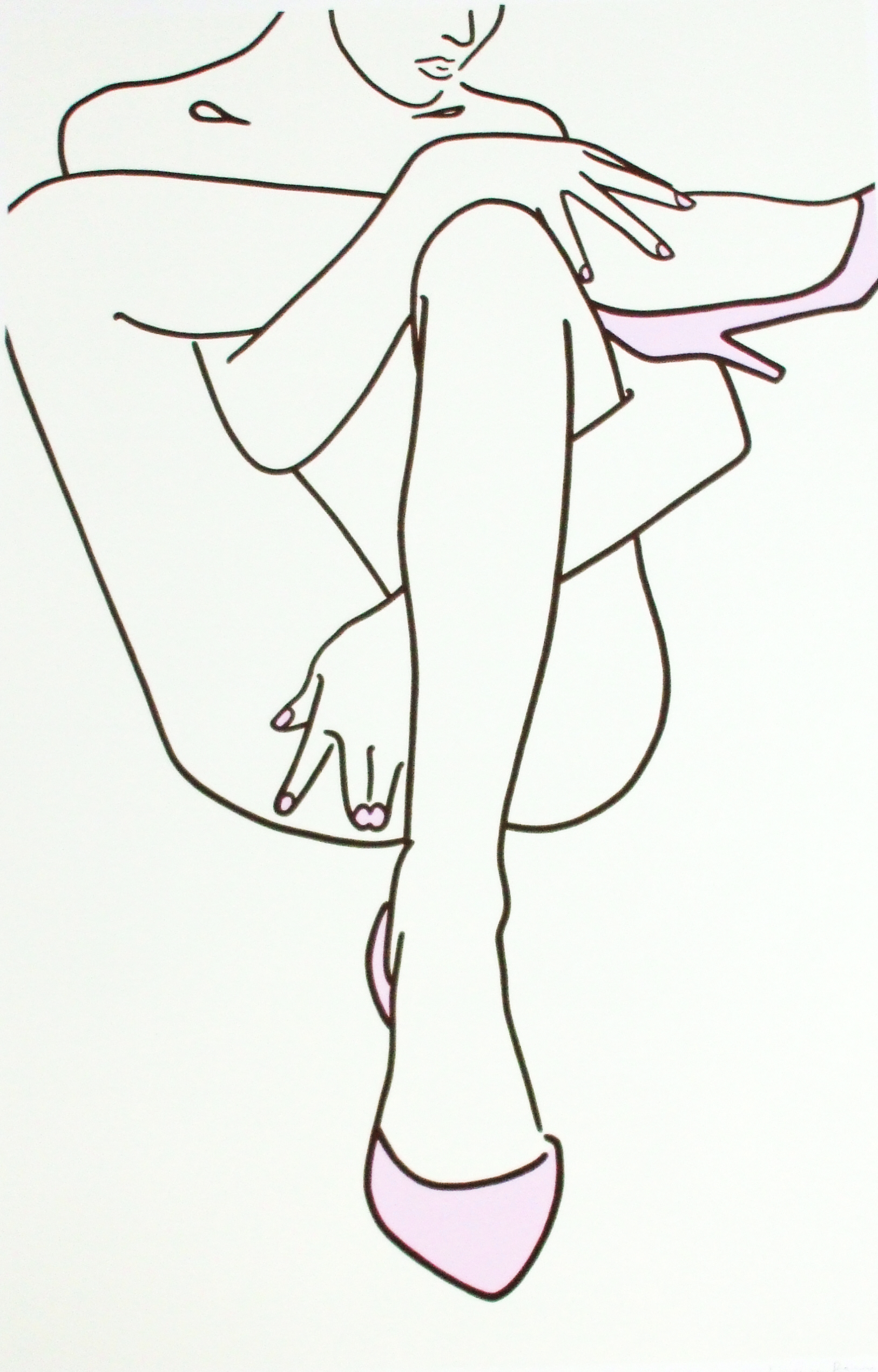
LUCIE BENNETT
Rose-coloured Shoes, 2005
Edition of 95
61(w) x 94(h) cm
24.02(w) x 37.01(h) inches
LUCIE BENNETT
Rose-coloured Shoes, 2005
Edition of 95
61(w) x 94(h) cm
24.02(w) x 37.01(h) inches
|
|
|
61(w) x 94(h) cm
24.02(w) x 37.01(h) inches
|
Screenprint on Somerset 410gsm paper
Edition of 95
|
|
The representation of
Lucie Bennett in the spring of 2005 was followed by the exclusive release of eleven screenprinted editions; one of the most significant print releases by a new artist in Eyestorm‘s history. An emerging artist at the time,
Pink Knickers,
Rose-coloured Shoes,
Airforce Blue,
Green Felt Tip Girl and
Red Felt-Tip Girl all represent the style that over the years Bennett has become well-known for. The screenprints each of 95, printed on Somerset Satin paper, are signed, titled and numbered by the artist on front. Between 2005 and 2019, Eyestorm has proudly released 27 editions on paper as well as two acrylic editions in collaboration with the artist.
To view the print editions in further detail and to find more information about available works by
Lucie Bennett, visit the artist’s page
here.